martedì 30 aprile 2019

CAROSELLI: SEMINA PRIMAVERILE

Pochi minuti fa ho messo a dimora i caroselli della prima semina: Tondo Barese, varietà ovale sconosciuta, Barese, Spuredda Leccese con macchie più chiare, Tondo di Massafra.
(1) Caroselli pugliesi: prima semina

Sono stati seminati tra il 20 e il 23 marzo. A tutt'oggi sono già così:
(2) Carosello Tondo Barese: una delle cinque varietà

Per la seconda semina, se ne parla quando saranno finiti i lavori sul balcone più grande.


CAROSELLI: SPRING SOWING

A few minutes ago I have put in the first sowing's caroselli: Barese Round, unknown oval variety, Barese, Spuredda Leccese with lighter splotches, Massafra Round (pic 1).

I sowed all five varieties between 20th and 23rd of March. As of today, they are like on pic 2.

As regards the second sowing, everything is put off till the end of the works on the larger balcony.

lunedì 22 aprile 2019

PROVA RIUSCITA

Non avevo mai coltivato un carosello da semi ricavati da un altro carosello cresciuto sul balcone. Il motivo era semplice: per fare semi sani, la pianta deve ricevere pochissima acqua, il che è fattibile  se è coltivata in piena terra. Al contrario, la stessa pianta coltivata in vaso ha bisogno di più acqua perché evapora molto velocemente quando la pianta è messa in vaso, anche se grande.
Beh, l'anno scorso ho voluto provare lo stesso a salvare dei semi di un Carosello Tondo di Massafra coltivato sul balcone. Quando il frutto prescelto per fare i semi è rimasto per ultimo sulla pianta, gli ho somministrato la minore quantità possibile di acqua fino alla sua raccolta.
È venuta fuori una pianta che sembra in ottima salute. Certo, occorre vedere come si comporterà in seguito:
(1)      22 aprile 2019: Carosello Tondo di Massafra

Ecco come sono arrivato a questa piantina:
(2)   8 luglio 2018: avevo scelto il frutto centrale per fare i semi per il 2019
(3)     23 luglio 2018
(4)     6 agosto 2018
(5)     6 agosto 2018

Una volta aperto per estrarre i semi, si presentava così:
(6)     7 agosto 2018
(7)     7 agosto 2018

Poi ho messo i semi in un vasetto finché la puzza del liquido non è diventata insopportabile:
(8) A riposo qualche giorno in un vasetto con liquido e placenta
(9) Semi messi a scolare e poi liberati dai resti della placenta...
(10) ...e messi ad asciugare


A SUCCESSFUL TRY

I had never cultivated a carosello from seeds of another carosello grown on a balcony. The reason was simple: in order to save healthy seeds, the vine has to receive the least possible quantity of water, which is viable if it is cultivated in open ground. On the contrary, the same vine grown on a balcony needs more water because it evaporates very quickly when the plant is in a pot, however large it is.

Well, last year I wanted to try all the same to save seeds from a Carosello Massafra Round cultivated on one of my balconies. When the fruit chosen to save seeds was the last one left on the vine, I gave it very little water until I harvested it (pics 2 to 10).

The three, now two, carosello plants (pic 1) that have thrived from those seeds seem to be in good health. Certainly, it is necessary to be patient and see how the vine will behave later on...

venerdì 19 aprile 2019

SOPRAVVISSUTA ALL'INVERNO

Alla fine della scorsa estate, ho voluto testare la bontà dei semi ricavati dalle mie melanzane rosse. Sono nate tantissime piantine di Melanzana Rossa di Mormanno e Melanzana Rossa di Rotonda. Ho provato a fare superare loro l'inverno, ma sono sopravvissute solo due piantine di Melanzana Rossa di Mormanno. Ecco la più in salute delle due:
(1) Melanzana Rossa di Mormanno sopravvissuta all'inverno

OVERWINTERED

At the end of last summer, I wanted to test the quality of the seeds extracted from my red eggplants. A large amount of plants sprouted. I tried to get them through the winter, but only two plants of the Mormanno Red Eggplant have overwintered. The healthier of the two is shown above.

mercoledì 17 aprile 2019

CAROSELLI: PRIMA SEMINA

Quest'anno ho deciso di fare due semine: una in primavera e una ad inizio estate in modo da avere caroselli fino all'autunno.
(1) Caroselli 2019: prima semina
Come prima semina, sto coltivando cinque varietà:
  • Carosello Barese
  • Carosello Tondo Barese
  • Carosello Tondo di Massafra
  • Spuredda Leccese Scura con macchie chiare
  • Varietà ovale sconosciuta
Per quanto riguarda i pomodori, riflettori puntati sul Casilino di Cerveteri.
(2) Pomodoro Casilino di Cerveteri


CAROSELLI: FIRST SOWING

This year I have decided to sow caroselli twice: the first time in spring and the second at the beginning of summer as to harvest them until fall. As first sowing, I have been cultivating five varieties (pic 1):

1) Carosello Barese
2) Carosello Barese Round
3) Carosello Massafra Round
4) Spuredda Leccese Dark with light splotches
5) Unknown oval variety 

As regards tomatoes, the Cerveteri Casilino is going to be in the limelight (pic 2). 

venerdì 29 marzo 2019

AVVIO IN SORDINA

Non sarà un anno facile per la mia attività di ortolano da balcone. Tutta colpa di alcuni lavori...
(1)
(2)

Lo spazio a disposizione non sarà molto, ma sarà quasi tutto dedicato ai caroselli. Per il momento solo cinque varietà, ma tra un paio di mesi ci sarà una seconda semina in modo da mangiarli fino ad autunno inoltrato. 
Grazie al mio amico americano Jay Tracy, sono riuscito ad avere i semi di Carosello Tondo Barese, ormai introvabili nei vivai pugliesi. Sì, avete letto bene, un americano che ama i caroselli. I semi che  Jay salva ogni anno sono di primissima qualità: germinano in meno di una settimana con un'altissima percentuale.
(3) Carosello Tondo Barese seminato il 20 marzo


STARTING SOFTLY

It won't be an easy year for my balcony gardening activity, because of some works (1 and 2).

The room at my disposal won't be much, but almost all of it will be dedicated to caroselli. For the time being, just five varieties, but in a couple of months there'll be a second sowing so as to eat them until late fall.

Thanks to my American friend Jay Tracy, I got Carosello Barese Round seeds (3) that cannot be found in all Puglia nurseries. Yes, you've read well, an American who loves caroselli. The seeds he saves every year are top quality: they germinate in less than a week with a very high success rate. 

lunedì 4 febbraio 2019

PROVE TECNICHE...

...in attesa della primavera. Ho appurato che le cime di rape (leggi qui) in vaso sul balcone non vale la pena coltivarle: tutte foglie e poche cime. Al contrario, la rucola, che ho seminato a settembre, sta superando brillantemente l'inverno: 64 piantine, tutte in buona saluta.
Ecco alcuni esemplari:
(1)
(2)
(3)
(4)
(5)


WAITING FOR THE SPRING

I've ascertained that it isn't worthwhile to cultivate turnip greens in pots (read here) on a balcony: lots of  leaves and just few tops.

On the contrary, arugula, I sowed in September, has been brilliantly overwintering: 64 seedlings, all of them in good health (pics 1 to 5).

giovedì 20 dicembre 2018

ORTO INVERNALE 2018-19

Un timido tentativo di fare giardinaggio in inverno. Ho voluto provare se la cima di rapa cresce bene in vaso.
(1) Cima di rapa quarantina
(2) Cima di rapa quarantina
(3) Cima di rapa quarantina

L'ho seminata ad inizio settembre, quindi avrei dovuto già mangiarla a metà ottobre. Invece, siamo nella seconda metà di dicembre e le piante hanno sviluppato solo una misera cimetta centrale. Finora mi sono dovuto accontentare di mangiare le foglie lesse.
(4) Cima di rapa quarantina

La rucola invece mi sta sorprendendo. Da inizio settembre sto curando un centinaio di piantina. Avevo la speranza che almeno una su cinque avrebbe potuto superare l'inverno. Sembra, invece, che vogliano sopravvivere tutte, nonostante il freddo intenso...

(5) Rucola
(6) Rucola


WINTER GARDEN 2018-19

Just a timid attempt to do gardening in winter. I have wanted to try whether turnip greens grow well in pots (1 to 3).

I sowed them at the beginning of September to be ready in mid-October. But we are in the second half of December and plants have produced only a small central top (4). So far I have eaten only boiled leaves.

Arugula is surprising me, instead. I have been cultivating about a hundred of small plants since the beginning of September (5 and 6). I hoped one out of five would overwinter, but so far all of them have been in good health in spite of intense cold...

sabato 13 ottobre 2018

POMODORO ROMA DI ARTENA

Doveva essere una pianta nana, alta non più di 30-40 centimetri...
(1) Pomodoro Roma di Artena

...ma evidentemente questa varietà non è ancora stabile, visto che ha superato il metro di altezza. I suoi rami non si sono sviluppati molto conferendo alla pianta un aspetto slanciato verso l'alto. Si è dimostrata molto prolifica con pomodori di media pezzatura, tra i 50 e i 60 grammi. Comunque, prima di emettere sentenze definitive, è meglio aspettare che il Roma di Artena si stabilizzi. L'anno prossimo ne saprò un po' di più, se avrò spazio sufficiente per poterlo coltivare ancora.
(2) Pomodoro Roma di Artena
(3) Pomodoro Roma di Artena
(4) Pomodoro Roma di Artena
(5) Pomodoro Roma di Artena

Li ho sempre mangiati in insalata raccogliendoli quando non erano molto maturi, ma credo che siano particolarmente adatti per fare il sugo. All'interno, infatti, il Roma di Artena è risultato molto polposo. 
(6) Pomodoro Roma di Artena


ARTENA ROMA TOMATO

It was supposed to be a dwarf vine, tall no more than 30-40 cm, but it isn't clearly a stable variety yet because it's more than one meter high (1). Its branches aren't very expanded and this gives to the plant a slender appearance upward. 

It proved to be very productive with medium size tomatoes, between 50 and 60 grams (2 to 5). Anyway, it's better to wait for Artena Roma Tomato to become more stable before making a final judgement. Next year I'll have clearer evidence about it, if I'll have room enough to grow it again.

I've always eaten these tomatoes as salad harvesting them when they weren't very ripe, but I think they are very suitable for making tomato sauce. As a matter of fact, the Artena Roma Tomato is very fleshy inside.

martedì 2 ottobre 2018

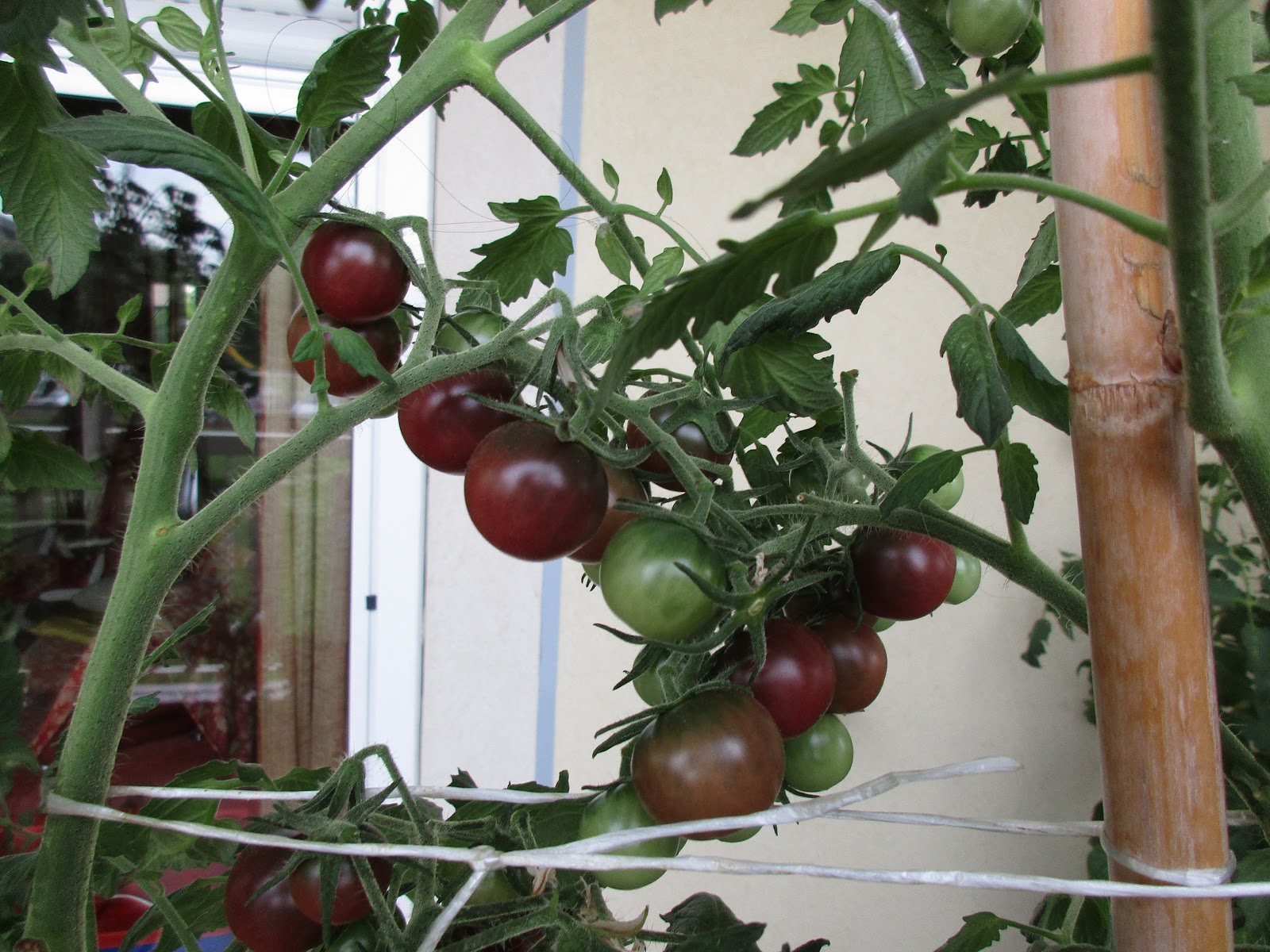
POMODORINO BLACK CHERRY

Il pomodorino Black Cherry è una varietà a crescita indeterminata. Come tutte le varietà indeterminate, cresce molto alta. Per questo è preferibile cimarla dopo il quarto o quinto palco di frutti, in modo da favorire la crescita ottimale dei frutti già presenti sulla pianta.
Il peso del frutto varia dai 7-8 grammi ai 10 grammi.
(1) Pomodorino Black Cherry
(2) Pomodorino Black Cherry - sezione longitudinale
(3) Pomodorino Black Cherry - sezione orizzontale

I pomodori neri sono chiamati anche pomodori anticancro perché sono ricchi di antocianine, pigmenti vegetali caratterizzati da notevoli proprietà antiossidanti.
Le piante di pomodorino Black Cherry non amano troppo il sole diretto, come tutte le varietà di pomodoro nero. Danno raccolti abbondantissimi.
(4) Pomodorino Black Cherry
(5) Pomodorino Black Cherry
(6) Pomodorino Black Cherry
(7) Pomodorino Black Cherry

L'unico difetto di questa varietà è che già a fine luglio diventa così...
(8) Pomodorino Black Cherry
(9) Pomodorino Black Cherry

Si forma una strana fuliggine che compromette parte del raccolto totale. O almeno, così sono diventati i miei Black Cherry nei due anni che li ho coltivati.


BLACK CHERRY TOMATO

The Black Cherry tomato is an indeterminate growth variety. Like all indeterminate  varieties, it grows very tall. For this it is better to head it down after the fourth or fifth cluster of fruits in order to help the optimal growth of pre-existing fruits.

The weight of this small tomato ranges from 7-8 grams to 10 grams (1 to 3).

Black tomatoes are also called anticancer tomatoes because they are rich in anthocyanins, vegetable pigments characterised by notable antioxidant properties.

Black Cherries vines don't love the direct sun too much, like all black tomatoes.

They give bountiful harvests (4 to 7).

The only fault of this strain is that it becomes like in photos 8 and 9 already at the end of July: a mysterious blight compromises part of the total production. Or at least this is what has occurred to my Black Cherries in the two years I cultivated  them so far.

sabato 22 settembre 2018

CAROSELLO MEZZO LUNGO DI POLIGNANO - 2018

Dovrebbe essere così...
(1) Mezzo Lungo di Polignano coltivato nel 2012

...invece quest'anno ha deciso di assumere altre forme e tutte diverse tra loro sulla stessa pianta.
(2) Mezzo Lungo di Polignano
(3) Mezzo Lungo di Polignano
(4) Mezzo Lungo di Polignano

L'unico con una forma quasi normale:
(5) Mezzo Lungo di Polignano

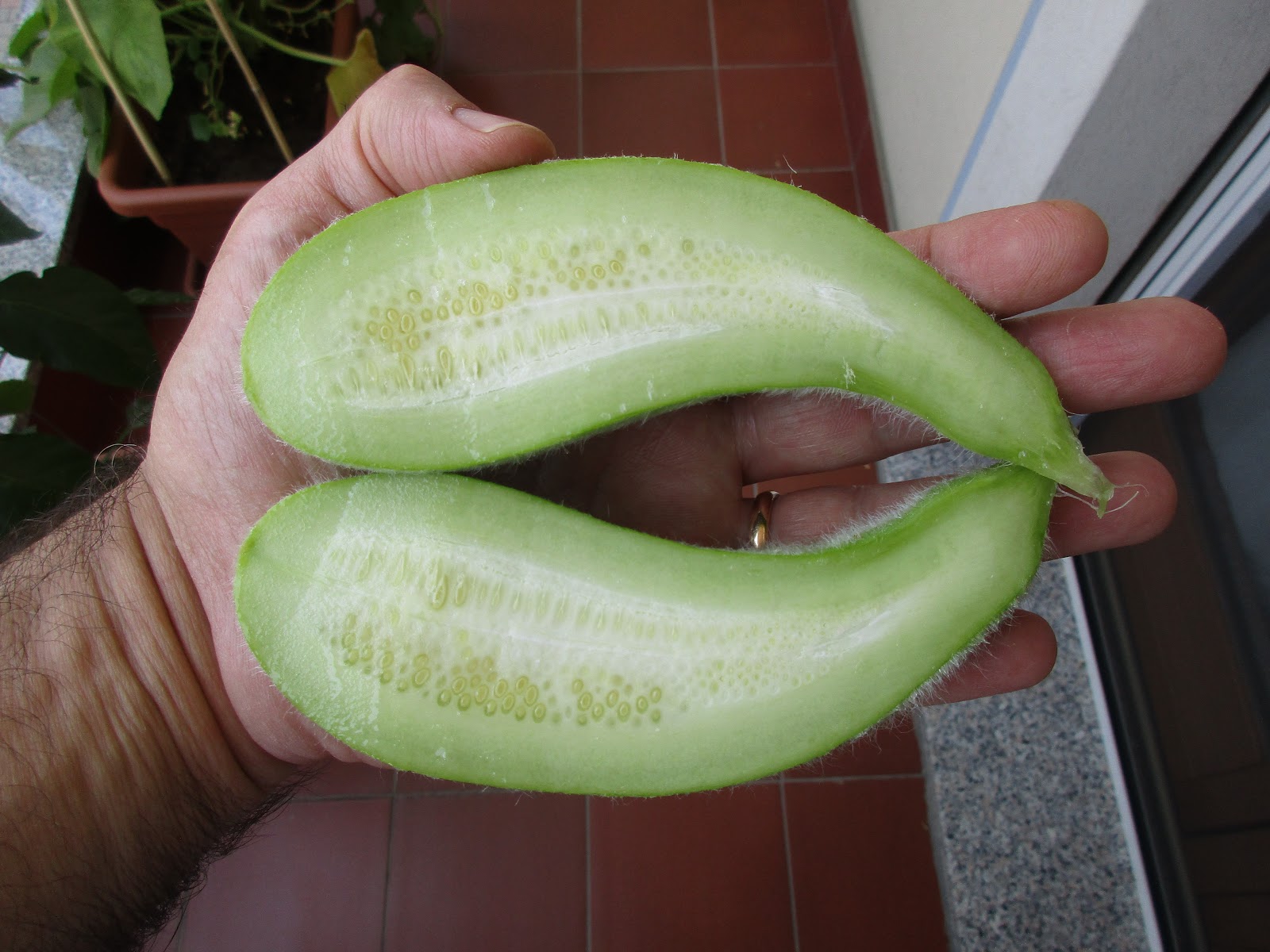
Non è tra i miei caroselli preferiti: un po' troppo secco e croccante. Va raccolto quando raggiunge i 13-15 cm, anche se molti lo raccolgono quando è lungo appena 10 cm. Troppo piccolo. È caratterizzato da una folta peluria.
(6) Mezzo Lungo di Polignano
(7) Mezzo Lungo di Polignano - sezione longitudinale


CAROSELLO POLIGNANO HALF LONG

The regular Carosello Polignano Half Long is like the one on pic 1 I cultivated in 2012, but this year it has taken different shapes on the same vine (2 to 4). On pic 1 the only fruit with an almost standard shape.

It is not among my favourite caroselli because it is a little bit too dry and crunchy. It must be harvested when it is 13-15 cm (5 and 6), though most gardeners pick it up at 10 cm. Too small. The fuzz factor is very conspicuous.