giovedì 27 aprile 2017

L'IMPORTANZA DI AVERE I DOPPIONI

Uno dei momenti più tristi del lavoro di un ortolano da balcone è quando si accorge che ha coltivato più piante di quante i suoi balconi possano contenerne. Ho già piazzato qualche pianta di pomodoro e melanzane; ora dovrò rincorrere qualche amico per regalare loro qualche pianta di carosello. L'alternativa è buttarle, ma voi avreste il coraggio di eliminare piante belle come quelle nella foto 1?
(1) Carosello Polisello e Carosello Spuredda Tarantino

Il Carosello di Manduria non sembra passarsela molto bene...
(2) Carosello di Manduria morente

...perciò qualche volta torna utile aver seminato doppioni. Così domani sarà sostituito dal suo gemello che scalpita in un misero vasetto da 10 cm.
(3) Carosello di Manduria di riserva

E se anche il gemello non convincerà il giardiniere, come in questo caso, c'è sempre tempo per seminarne un altro (a dire il vero, l'ho già fatto!).


THE IMPORTANCE OF HAVING SPARE PLANTS

One of the saddest moments of a balcony gardener activity is when he realizes that he has cultivated more plants than his balconies can hold. I've already given some tomato and eggplant plants away; now I'll have to chase after some friends to give them some carosellos plants. The alternative is to throw them away, but would you have the heart to eliminate plants as robust and healthy as the ones on pic 1?

The Carosello Manduria seems to be badly off (pic 2). So it sometimes comes useful to sow spare plants. This is why tomorrow it'll be replaced by its twin that is currently in a tiny 10 cm pot (pic 3). And if the twin plant doesn't live up to the gardener's expectations as well, and this is the case, there's plenty of time for sowing another one (actually, already done!).

giovedì 20 aprile 2017

MELANZANE 2017

Anche le piantine di melanzana non se la stanno cavando male. Cominciamo da una vecchia amica, la Melanzana Rossa di Rotonda (vedi qui).
(1) Melanzana Rossa di Rotonda

La prossima è una Melanzana Rossa Costoluta. Ho avuto i semi da un amico giardiniere romagnolo che ne ignora il nome. Spero di scoprirlo alla fine della stagione.
(2) Melanzana Rossa Costoluta

La successiva è la Melanzana Rossa di Mormanno. L'ho seminata un po' più tardi rispetto alle altre. Anche l'anno scorso ero convinto di aver seminato questa melanzana proveniente dal versante calabrese del massiccio del Pollino, ma subito mi sono accorto essere una Rossa di Rotonda che nasce nel versante lucano di questo gruppo montuoso dell'Appennino meridionale.
(3) Melanzana Rossa di Mormanno

La Melanzana Rossa di Mormanno è in questo video: compare all'inizio del filmato. Il signore intervistato nel video è il professor Orlando Sculli, salvatore di tanta biodiversità calabrese. È lui che mi ha mandato i semi, perciò vado sul sicuro.

Un tocco di esotico con le prossime due: la Melanzana Verde Tonda Tailandese e la Melanzana Claveria Long Purple. La prima è molto popolare soprattutto in Tailandia e Vietnam mentre la seconda prende il nome dalla città di Claveria, situata nell'estremo Nord delle Filippine.
(4) Melanzana Tonda Verde Tailandese
(5) Melanzana Claveria Long Purple

Le macchie bianche che vedete su tutte le piantine sono zolfo e rame che ho spruzzato per combattere la peronospora.


2017 EGGPLANTS

The eggplants have been doing very nicely as well. Let's start with an old friend, the Rotonda Red Eggplant (pic 1) (see here).

On pic 2 is a Ribbed Red Eggplant. I got the seeds from a friend who ignores the name of this strain. I hope to find it out at the end of the season.

On pic 3 is the Mormanno Red Eggplant. I sowed it a little bit later than the others. Last year too I was sure I had sown this eggplant coming from the Calabrian side of the Pollino massif, but soon I noticed it was a Rotonda Red that grows up on the Basilicata side of this mountainous group of South Italy Apennines.

The Mormanno Red Eggplant is in this video: it shows up at the beginning of the clip. The gentleman interviewed in the video is mister Orlando Sculli, saver of  so much Calabrian biodiversity. He sent me the seeds , so I'm quite sure that they are the right ones.

An exotic touch on pics 4 and 5: the Thai Round Green Eggplant and the Claveria Long Purple Eggplant. The former is mainly popular in Thailand and Vietnam; the latter is named after Claveria, a town located in the extreme north of the Philippines.

The white spots you see on all plants are sulphur and copper I sprinkled to fight downey mildew.

IL PRIMO RACCOLTO DEL 2017

Solo quattro fragole, raccolte ieri pomeriggio. Poca roba, è vero. Giusto per incominciare...
Fragole - varietà Quattro Stagioni


THE 2017 FIRST HARVEST

Only four strawberries, Four Seasons variety, harvested yesterday afternoon. 
I admit it's not much. Just a start...

sabato 15 aprile 2017

NON SONO SICURO DI ESSERE CONTENTO...

...di questa primavera estiva. Se da un lato non ho mai avuto piantine così sviluppate a questo punto dell'anno, è anche vero che l'allarme lanciato dagli esperti sui cambiamenti climatici non è campato in aria. Marzo e finora aprile sono stati i più caldi che io ricordi. Vi sembra normale che ad aprile faccia caldo come a giugno?
Come potete vedere dalle foto 1, 2 e 3 le piante di pomodoro scoppiano di salute.
(1) Pomodori 2017
(2) Pomodoro Tondo Liscio Tondino

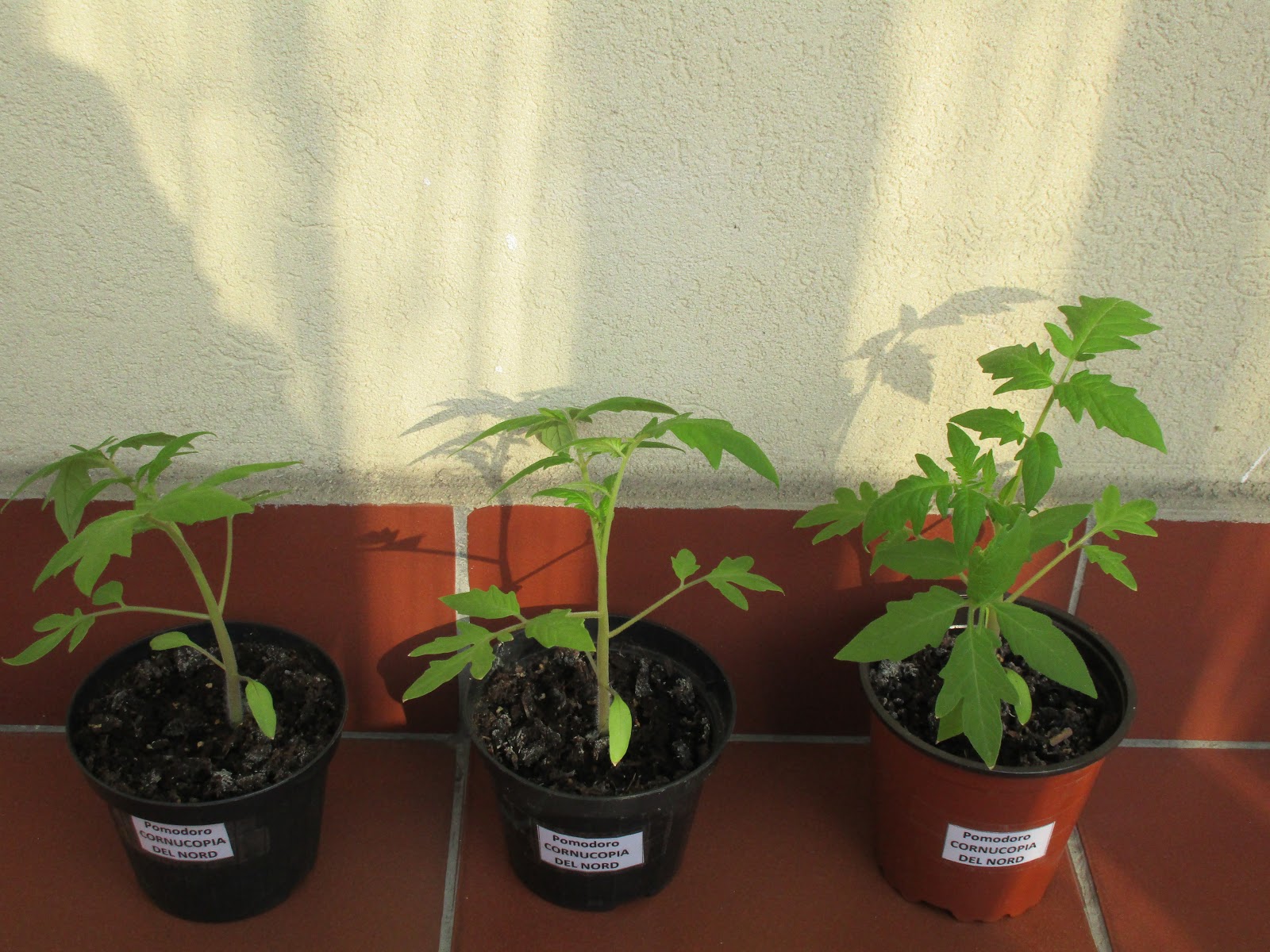
(3) Pomodoro Cornucopia del Nord

Anche i caroselli hanno approfittato del clima insolitamente caldo: sono germinati in quattro-cinque giorni, tranne il Bianco Leccese che ha fatto capolino solo tre giorni fa. Ho messo a dimora alcune varietà con almeno due-tre settimane di anticipo.
Ci sono alcuni "vecchi amici" che ho già coltivato in passato. A dire il vero, l'unica varietà veramente inedita è il Carosello Spuredda Tarantino. L'anno scorso ho coltivato anche il Carosello Polisello, ma solo per fare semi freschi. Non ho pubblicato un post su di esso nel 2016, ma solo qualche foto.
(4) Carosello Polisello 2017
(5) Carosello Spuredda 2017

Ecco la lista delle varietà di quest'anno:

Carosello Bianco Leccese
Carosello di Manduria
Carosello Mezzo Lungo di Polignano
Carosello Polisello
Carosello Spuredda Tarantino
Carosello Tondo Barese
Carosello Tondo di Manduria

Un po' di spazio anche alle "colture minori". Mi sono lasciato convincere dal resto della mia famiglia a comprare qualche piantina di fragole. Ho i miei dubbi... Sembra che le fragole siano "portatrici sane" di oidio, alias mal bianco. E questo è un pericolo serio per i miei caroselli...
 (6) Fragole - varietà Quattro Stagioni


I'M NOT SURE I'M HAPPY...

...about this summery spring. In a sense, I've never had so strong and well-grown plants  at this point of the year; but it's also true that the experts' warning about the climatic changes is a serious matter. March and so far April have been the hottest ones I recall. Is it normal that the weather in April is as hot as in June?

As you can see on pics 1, 2 and 3 my tomato plants are bursting with health.

The carosellos have taken advantage of the abnormally hot weather as well: they have germinated in four or five days, except the Bianco Leccese that peeped out just three days ago. I've bedded out some of them at least two or three weeks earlier than usual (pics 4 and 5).

My 2017 carosello list includes some "old friends" I've already cultivated in the past. Actually, the only really new strain is the Carosello Spuredda Tarantino. Last year I grew the Carosello Polisello as well, but only to save fresh seeds. I've never published a post about it in 2016, but just a few pictures.

A little space to a "lesser crop" as well. My family (wife, daughter and son) convinced me to buy some strawberry plants, Four Seasons variety (pic 6). I'm not sure it's a good idea... It seems that strawberries are "carrier" of  powdery mildew. And this is a serious danger for my carosellos...

sabato 25 marzo 2017

LE PIANTINE DI POMODORO UN MESE DOPO

È stato un marzo a dir poco sorprendente da un punto di vista del tempo atmosferico. Soleggiato e caldo. Non ho mai avuto piantine di pomodoro così belle e ben sviluppate all'inizio della primavera.
(1)

Questo anno torno a coltivare una varietà già provata nel 2014 e il 2015: la Cornucopia del Nord (qui). È determinata e non ama molto il sole diretto.
(2) Cornucopia del Nord

C'è un problema, però. E non di poco conto: la lista si è allungata. Ogni anno cerco di contenere il numero delle piante, ma poi qualche amico giardiniere mi manda nuove varietà...
Ecco la lista definitiva:

Black Cherry (indeterminato)
Ciliegia Selezione Rotondino (indeterminato)
Tondo Liscio Tondino (indeterminato)
Cornucopia del Nord (determinato)
Fiaschetto Piccolo (determinato)
Hahms Gelbe Topftomate (determinato nano)
Datterino Volunteer (determinato nano)
Tiny Tim (determinato nano)
Fiaschello di Battipaglia (determinato)
Cannellino Flegreo Basso (determinato)
Piennolo del Vesuvio (determinato)
Vesuvio (indeterminato)

I nuovi arrivati provengono dall'area campano-flegrea. In più, alcune varietà di questa lista sono indeterminate, perciò dopo il quinto o sesto palco di frutti dovrò procedere alla cimatura del tronco principale. Si fa nella coltivazione in piena terra, figuriamoci su un balcone...


THE TOMATO PLANTS ONE MONTH LATER

It's been an unusually sunny and warm March. I've never had so beautiful and well-grown tomato plants at the beginning of spring.

This year I'm cultivating the Cornucopia del Nord again (here), as in 2014 and 2015. It's a determinate strain which doesn't love the direct sun.

But there's a problem. And not a trivial one: the list has lenghtened. Every year I try to contain the number of plants, but there are always some gardener pals sending new varieties...

Here you are the ultimate list:

Black Cherry (indeterminate)
Cherry Selection Small Round (indeterminate)
Round Smooth Tondino (indeterminate)
Cornucopia del Nord (determinate)
Small Flask (determinate)
Hahms Gelbe Topftomate (dwarf determinate)
Volunteer Datterino (dwarf determinate)
Tiny Tim (dwarf determinate)
Battipaglia Small Flask (determinate)
Small Cannellino Flegreo (determinate)
Piennolo del Vesuvio (determinate)
Vesuvio (indeterminate)

I tried to translate as best as I could the names of all Italian strains.

The new entries come from the volcano Vesuvio area. Moreover, some of these strains are indeterminate, so I'll have to trim the main stem after the fifth or sixth cluster of fruits. Gardeners do that in the open ground, imagine on balconies...

sabato 25 febbraio 2017

PRIMO BAGNO DI SOLE PER LE MIE PIANTINE

Giusto un piccolo aggiornamento dai miei balconi. Oggi pomeriggio ho approfittato del sole primaverile per mettere al sole diretto le mie piantine di pomodori e melanzane.
(1)

(2)

(3)

(4)

In attesa dei caroselli...


FIRST SUNBATHING FOR MY SEEDLINGS

Just a small update from my balconies. This afternoon I took advantage of the spring day to put my tomatoes and aubergines seedlings in the sun outside.

Waiting for carosellos...


giovedì 16 febbraio 2017

SEMINA 2017

È ancora troppo presto per seminare i caroselli, ma non i pomodori e le melanzane in un lightbox molto improvvisato: la mensola della cucina, posizionata a 10 cm di distanza sopra il termosifone, e la lampada da scrivania di mio figlio.
Ho iniziato per gioco, ma sta funzionando! La temperatura non supera i 25 °C quando il riscaldamento è acceso; non scende mai sotto i 18 °C quando è spento. 
(1) Pomodori 2017

(2) Melanzane 2017

Ecco la mia lista molto provvisoria per quest'anno per quanto riguarda pomodori e melanzane, seminati il primo giorno di febbraio.

POMODORI:
Black Cherry (indeterminato)
Ciliegia Selezione Rotondino (indeterminato)
Tondo Liscio Tondino (indeterminato)
Cornucopia del Nord (determinato)
Fiaschetto Piccolo (determinato)
Hahms Gelbe Topftomate (nano)
Datterino (nano)
Tiny Tim (nano)

MELANZANE:
Rossa di Rotonda
Rossa Costoluta
Viola Piccola Siciliana
Verde Thai

La lista è provvisoria perché sto aspettando da un amico giardiniere una chicca, il Pomodoro Fiaschello Battipagliese e altre varietà di melanzane. Un amico romagnolo, invece, mi ha mandato i semi di una melanzana rossa costoluta di cui ignora il nome. Dovrò aspettare che cresca e fare delle ricerche per scoprirne il nome. Non vedo l'ora di studiarne le differenze con la Rossa di Rotonda.


SOWING - 2017

It's still too early to sow carosellos, but not tomatoes and aubergines in a very makeshift lightbox: a kitchen shelf, placed about 10 cm over the radiator, and my son's desk lamp.
I started just for fun, but it's working! The temperature doesn't exceed 25 °C when the heating is on; it never drops under 25 °C when it's off.

On pictures 1 and 2 are respectively seedlings of tomatoes and aubergines, sown on the 1st of February.

The list for tomatoes and aubergines are still temporary because I'm expecting some new varieties from friends, among which I'm looking forward to receiving seeds of a tomato cultivated in South Italy, more precisely south of the Napoli area, the Fiaschello Battipagliese. Another friend sent me seeds of another nameless red aubergine. He has called it Ribbed Red Aubergine for its shape. I'll have to expect it to grow and do research on it to find out its name. I can't wait to study the differences between this new aubergine variety and the Rotonda Red Aubergine.

lunedì 14 novembre 2016

MELANZANA ROSSA DI ROTONDA - Qualche ricetta

"Belle, ma come si mangiano?" È la seconda cosa che mi chiede la gente quando vede le mie melanzane rosse. La prima è: "Ma sono davvero melanzane? Sembrano dei pomodori!"
Vediamo come si possono preparare. Nei primi anni anni di coltivazione mi limitavo sempre alla stessa ricetta: tagliavo le melanzane rosse a fette, le sbollentavo per un minuto in acqua e aceto bollenti, quindi le facevo asciugare in un piatto dopo averle cosparse con poco sale. Come si può notare, rispetto alle melanzane tradizionali, una volta tagliate, non scuriscono per il basso contenuto di acido clorogenico.
(1)

La loro destinazione finale era sempre di finire sottolio con aglio, origano, menta e rosmarino.
(2)
Poi la folgorazione. Durante un viaggio a Matera nell'estate 2015, in un negozio ho visto un vasetto di crema di melanzane rosse che non ho comprato per il costo esorbitante, ma mio figlio ha fatto una foto al coperchio dove erano scritti gli ingredienti. L'idea era di fare io stesso una crema di melanzane rosse una volta tornato a casa.
(3)

Non ero sicuro di riuscire a fare una crema che soddisfacesse le esigentissime donne di casa mia. Invece, è stato un successone. Ho messo nel frullatore le melanzane crude, tagliate a pezzi grossolani, e tutti gli altri ingredienti. Il dosaggio degli ingredienti stessi è stato fatto a occhio, ma attenti a non esagerare con l'aceto. La crema ottenuta spalmata sui crostini o anche semplicemente sul pane è gustosissima.
(4)

Una volta messa nei vasetti, aggiungete olio finché non copre tutta la crema. Aspettate più o meno una settimana e si può mangiare.
(5)

Ma il bello deve ancora venire. Esiste un sito ufficiale della Melanzana Rossa di Rotonda dove ho trovato un ricettario. A dire il vero, ultimamente questo sito sembra funzionare male o non funzionare affatto. Comunque, la scorsa estate mia moglie si è cimentata con due ricette: Polpette di Melanzana Rossa di Rotonda e Melanzana Rossa di Rotonda alla Castelluccese.
(6) Polpette di Melanzana Rossa di Rotonda
(7) Melanzana Rossa di Rotonda alla Castelluccese

Inutile aggiungere che si sono rivelate una delizia...


THE ROTONDA RED AUBERGINE - A few recipes

"Beautiful, but how do you eat them?" It's the second thing people ask me when they see my red aubergines. The first is: "Are they really aubergines? They look like tomatoes!"

Let's see how to prepare them. When I started to cultivate them, I always restricted myself to the same recipe: I cut the red aubergines into slices, blanched them in hot water and vinegar for one minute, then I made them dry on a plate after sprinkling them with little salt. As you can notice, if compared with traditional aubergines, they don't turn brown once cut because of the low level of chlorogenic acid (pic 1).

Their final destination was always to finish under oil with garlic, oregano, mint and rosemary (pic 2). 

Then, a brilliant idea struck me. During a holiday in Matera in summer 2015, in a shop I saw a small jar of red aubergine spread which I didn't buy because really very expensive, but my son took a picture of the top where all ingredients were listed (pic 3). Once back home, I would make my personal red aubergine spread.

I wasn't sure I could make a spread good enough for my wife and daughter because they are particular about food. But it was a big success. I put in a blender the raw aubergines, cut into rough pieces, and all other ingredients. The amount of the ingredients themselves was made roughly, but don't exaggerate with vinegar. This paste is very tasty if spread on croûtons or just only on slices of bread (pic 4).

Once you put the spread in small jars, add oil until it covers all of it. Then wait one week or so and eat it (pic 5).

The best part's yet to come. There exists the official site of the Rotonda Red Eggplant where I found a cookbook (it's in Italian, but I can translate some recipes if you are interested). Actually, this site doesn't seem to work properly, at times it doesn't even work at all. Anyway, last summer my wife decided to try out with two recipes: Polpette di Melanzana Rossa di Rotonda (pic 6) and Melanzana Rossa di Rotonda alla Castelluccese (pic 7). It's no use saying that they proved to be exquisite.

mercoledì 2 novembre 2016

POMODORO DATTERINO SICCAGNO

È una varietà a crescita determinata. L'aggettivo "siccagno" lascia intendere che in piena terra viene coltivato con poca acqua, il che non è possibile se lo fate in un vaso.
L'ho coltivato in un vaso da 26 cm; temevo che non sarebbe stato sufficiente per una crescita accettabile della pianta. Invece, mi sbagliavo.
(1) Pomodoro Datterino Siccagno

Data la polpa molto spessa, è adattissimo per fare il sugo, ma anche in insalata è degno dei palati più sopraffini.
(2) Pomodorino Datterino Siccagno - sezione

La forma è quella di un datterino. 
(3)

Tuttavia, questa varietà è caratterizzata da un discreto polimorfismo dei frutti. Notate il pomodoro in primo piano nella foto 4. Presenta una solcatura centrale, non insolita in alcuni frutti.
(4) In primo piano pomodoro con costolatura centrale

Alcuni pomodori sono stati colpiti da marciume apicale. Niente di serio, solo pochi frutti.
(5) Datterino Siccagno colpito da marciume apicale

Le tre piante hanno prodotto numerosi raccolti abbondanti.
(6)


DATTERINO SICCAGNO TOMATO

It's a determinate growth variety. The adjective "siccagno" means something like "dry"; it gives to understand that in the ground it's cultivated with little water, which isn't possible if you do it in a pot.

I cultivated it in a 26 cm pot (pic 1). I was afraid it wouldn't be enough for an acceptable growth of the plant, but I was wrong.

It's particularly suitable for making the sauce because its pulp is very thick (pic 2), but also as a salad it's worthy of the most superfine palates.

The shape is that of a small date (pic 3), but this variety spotlights a moderate polymorphism of its fruits. On pic 4 you can notice a tomato in close-up with a furrowing on the middle. This isn't unusual in some fruits.

Some tomatoes were affected by blossom-end rot (pic 5). Nothing serious, just few fruits.

The three plants I cultivated yielded notable crops (pic 6).

venerdì 21 ottobre 2016

HAHMS GELBE - Pomodorino nano giallo

Qualche anno fa ho ricevuto dei semi di un pomodorino giallo a crescita determinata nana, l'Hahms Gelbe Topftomate, la cui traduzione dal tedesco è "pomodoro giallo da vaso Hahms".
Può essere coltivato in vasi minuscoli. All'inizio, è fondamentale che riceva molta luce. In questo modo questa varietà crescerà molto piccola, venti centimetri, non di più, ma ne beneficeranno sia il fogliame...
(1) Hahms Gelbe

...che la produzione di pomodorini.
(2)
(3)

È importante che non sia mangiato quando è giallo brillante: il sapore risulterebbe come quello di un pomodoro verde immaturo. Aspettate che i pomodorini diventino giallo oro/arancio perché solo in questa fase il loro sapore raggiunge il suo stato ottimale.
(4) I pomodorini in primo piano hanno raggiunto la piena maturazione

Sono molto dolci e succosi con una punta di acidità. La pelle è spessa e perciò si conservano a lungo.
Anche se è una pianta nana, suggerisco di mettere a sostegno una cannetta perché nel momento di massima produzione si riempe di tantissimi pomodorini che tendono a tirare giù la pianta con il rischio concreto che il piccolo fusto si spezzi.
(6) Senza un piccolo sostegno questa pianta era destinata a spezzarsi

L'Hahms Gelbe può essere coltivato anche in casa, sul davanzale di una finestra dove può ricevere molta luce. Personalmente non ci ho mai provato, ma voglio tentare prima o poi.


HAHMS GELBE - A Dwarf Yellow Tomato

A few years ago I got some seeds of a dwarf determinate yellow tomato, the Hahms Gelbe Topftomate; its translation from German is "Hahms pot yellow tomato".

It can be cultivated in tiny pots. At the beginning it's essential that it receives a lot of light. This way this variety will grow very small, no taller than 20 cm, but both the foliage and the yield of small tomatoes will benefit (pics 1 to 3).

It's important you don't eat the small globes when they are bright yellow: their taste would turn out as unripe as that of a green tomato. Just wait until they get golden yellow/orange because only at this stage their taste reaches its optimal state (pic 4).

The fruits are sweet and juicy with a bit of acidity. The skin is thick and for this they keep long (pic 5).

Even if it's a dwarf plant, I suggest to use a small support because when at its most productive period the fruits pull down the plant with a real risk that the small stalk snaps (pic 6).

The Hahms Gelbe tomato can be cultivated indoor on a windowsill where it can get lots of light. I've never tried that, but I will sooner or later.

venerdì 14 ottobre 2016

CAROSELLO TONDO DI MASSAFRA

È strettamente imparentato con il Carosello Tondo Massafrese (vedi qui). Le differenze tra i due sono veramente minime; anzi, posso dire, senza timore di essere smentito, che l'unica differenza riguarda il colore della buccia.
Meglio far parlare le foto: prima il Tondo di Massafra che è verde scuro con poche macchie di verde più chiaro...
(1) Carosello Tondo di Massafra
...o addirittura senza...
(2)
(3)

...poi il Tondo Massafrese che, al contrario, presenta macchie più evidenti di verde più chiaro su epicarpo verde scuro oppure tracce di verde scuro su epicarpo verde più chiaro, come qualche anno fa suggeriva anche il mio amico americano, il blogger Jay Tracy (vedi qui).
(4) Carosello Tondo Massafrese

A dire il vero, non è raro che su una pianta del Tondo di Massafra spuntino frutti con la buccia identica ad un Tondo Massafrese e viceversa. Guardate i due frutti nella foto 5: sono nati sulla stessa pianta di Tondo di Massafra la scorsa estate, ma quello sulla destra sembra un Tondo Massafrese.
(5)

Per il resto, sono praticamente fratelli gemelli: stessa forma tonda, anche se non è insolito vedere frutti ovali e oblunghi; stessa consistenza tra il morbido e il leggermente croccante; stesse solcature marcate in senso verticale; stesso gusto dolce e saporito. Ma quest'ultima caratteristica è comune a molte varietà di caroselli.
Jay Tracy dice che un'altra differenza tra queste due varietà è che il Carosello Tondo di Massafra produce frutti più vicino allo stelo principale. Non ne sono tanto sicuro, come dimostrano le foto 5 e 6.
(6)

Allo stesso modo, non sono sicuro che il Carosello Tondo Massafrese produca frutti più lontano dallo stelo principale (vedi qui). In entrambi i casi mi sembra che le due varietà producano frutti lontano dallo stelo principale sulla parte bassa e vicino a esso sulla parte centrale e superiore della pianta. In futuro l'argomento merita un approfondimento coltivando le due varietà lo stesso anno per studiarne meglio le differenze. Probabilmente tra un paio d'anni perché nel 2017 voglio dare spazio ad altre varietà di carosello di cui non ho ancora parlato in questo blog.
Devo ammettere che il mio Carosello Tondo di Massafra non è stato molto prolifico quest'anno, come mostra la tabella sotto: solo otto frutti quando la media è di almeno quindici, probabilmente perché i semi non erano freschissimi.

Frutti raccolti: 8 (da una singola pianta)
Peso complessivo: 1,882 kg
Peso medio per frutto: 235,25 grammi
Frutto più grosso: 330 grammi
Frutto più piccolo: 155 grammi


CAROSELLO ROUND MASSAFRA

It's strictly related to the Carosello Round Massafrese (see here). The differences between the two are marginal; or rather, without fear of being belied, I can say that the only difference concerns the colour of the skin.

The Round Massafra is dark green with few (or without in some cases) splotches of lighter green (pics 1 to 3). On the contrary, the Round Massafrese shows larger splotches of lighter green on a dark green skin (pic 4) or splotches of dark green on a lighter green skin, as my American friend, the blogger Jay Tracy, suggested a few years ago as well (see here).

To tell the truth, it isn't unusual that some fruits with the skin identical to a Round Massafrese show up on a Round Massafra vine and vice versa.This is apparent on pic 5: the two fruits sprang up on a Round Massafra vine last summer, but the one on the right seems a Round Massafrese. Apart from this, they are twins: same round shape, though it isn't rare to see oval and oblong fruits; same soft or slightly crunchy texture; same deep vertical furrows; same sweet and savoury taste. But this latter feature is common to lots of carosello strains.

Jay Tracy says that another difference between these two varieties is that the Carosello Round Massafra vine sets its fruits closer to the main stem, but I'm not sure about that, as shown on pics 5 and 6. I'm not even sure that the Carosello Round Massafrese sets its fruits farther from the main stem (see here). In both cases, it seems to me that the two varieties set their fruits far from the main stem on the lower part and close to it on the central and upper part of the vine. In the future I must go into the matter more thoroughly cultivating both strains in the same year to study the differences in a more appropriate way. Probably in a couple of years because in 2017 I want to make room for other carosello varieties I haven't talked about in this blog yet.

I have to recognize that my Carosello Round Massafra hasn't been very productive this year, as shown in the table below: only eight fruits whereas the average is fifteen at least, probably because the seeds weren't very fresh.

Fruits harvested: 8 (from a single plant)
Total weight: 1,882 kg
Average weight per fruit: 235,25 grams
Biggest fruit: 330 grams
Smallest fruit: 155 grams

sabato 8 ottobre 2016

I FIORI DELLA MELANZANA ROSSA DI ROTONDA

Nel mio post sulla Melanzana Rossa di Rotonda non ho fatto cenno ai fiori di questo ortaggio.  Sono ermafroditi e possono essere a cinque, sei o sette petali. I petali sono di un colore bianco candido mentre lo stame è di un giallo intenso. Lo stigma è rosso inizialmente, poi diventa giallo anch'esso. Lo stilo invece è di un giallo paglierino.
(1) Fiore di Melanzana Rossa di Rotonda a cinque petali

(2) Fiore di Melanzana Rossa di Rotonda a sei petali

(3) Fiore di Melanzana Rossa di Rotonda a sette petali


THE FLOWERS OF THE ROTONDA RED EGGPLANT

In my post about the Rotonda Red Eggplant, I didn't mention the flowers of this vegetable. They are hermaphroditic and can have five, six or seven petals. 

Its petals are snow-white whereas the stamen is striking yellow. The stigma is red at the beginning, then it gradually gets yellow as well. The style is straw-yellow instead.