domenica 25 settembre 2016

CAROSELLO MELONE TARANTINO

Devo ringraziare Angelo Passalacqua di amicidellortodue che lo scorso inverno mi ha mandato i semi di questa varietà. Circa un anno fa lui stesso ha pubblicato un post su questo carosello-melone sul suo blog (vedi qui).
A quanto pare, il Carosello Tarantino assomiglia al melone tradizionale ancor più del Barattiere. Osservate la foglia che è di un verde scuro: ricorda più quella del melone che non quella di un carosello.
(1) Carosello Tarantino - Foglia

La mia pianta ha prodotto cinque frutti. Se sei frutti da una pianta di Barattiere è un buon successo, credo che anche cinque da un Carosello Tarantino sia un risultato soddisfacente.
Il colore della buccia è verde con macchie di verde scuro in rilievo ed è molto coriacea se paragonata a quella dei caroselli. Si fa fatica a sbucciarla; conviene tagliare il frutto a spicchi e mangiarlo come il melone.
(2) Frutto sulla parte centrale della pianta

Come il carosello, nella sua fase iniziale presenta una fitta peluria che perde gradualmente con la crescita e non presenta ancora nemmeno tracce di verde scuro. Anche queste vengono dopo.
(3) Peponide nella sua fase iniziale
(4) Lo stesso della foto precedente dopo due giorni

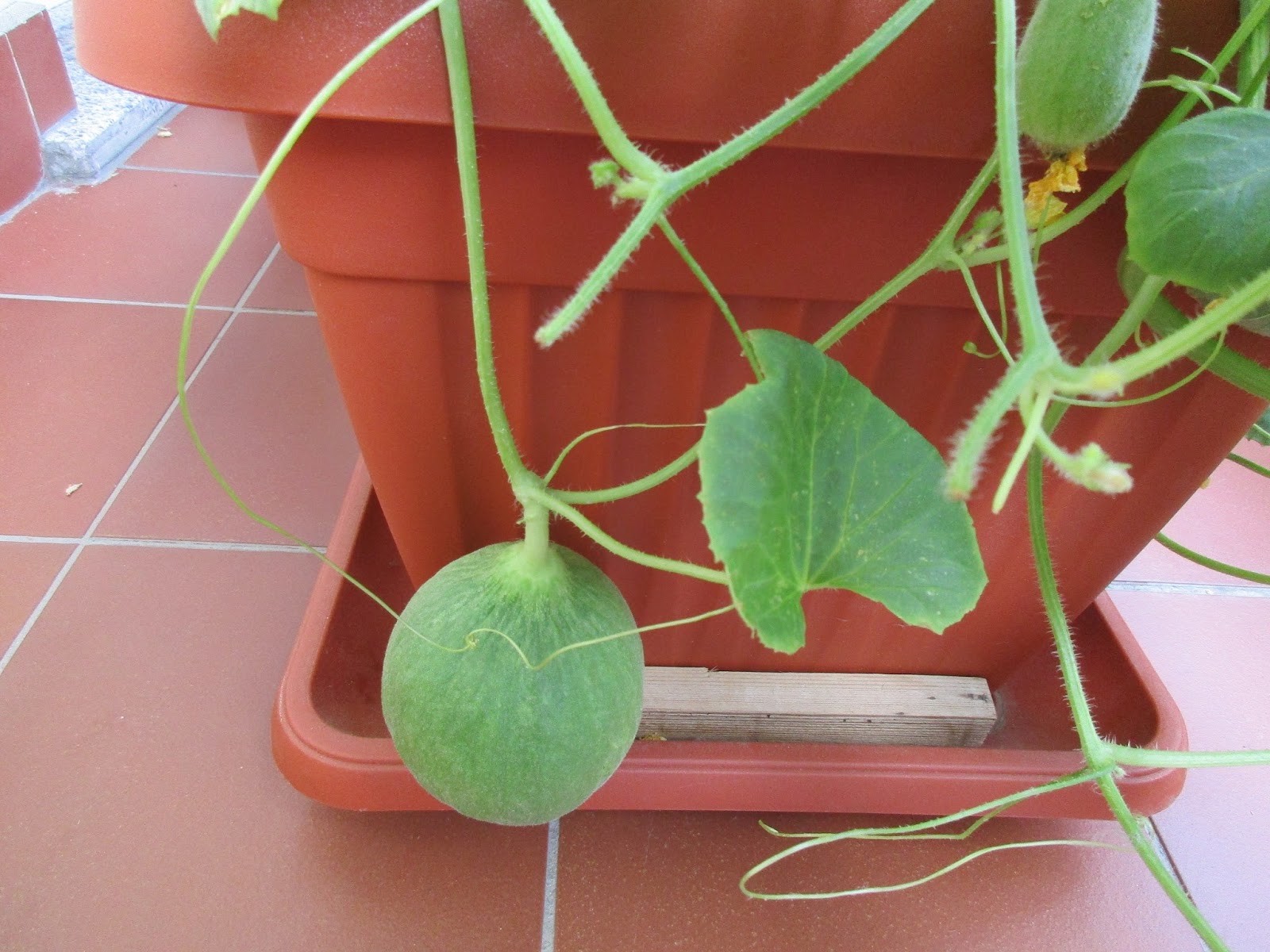
Tre dei cinque frutti sono nati sulla parte inferiore della pianta...
(5)
(6)

...perciò la prossima volta mi conviene cimare lo stelo principale molto prima che raggiunga i due metri visto che la parte superiore mi sembrava poco propensa a produrre. È probabile che in questo modo la parte inferiore della pianta possa sviluppare altri frutti.
(7)

Per finire, l'interno di un frutto; la polpa è tenera quasi quanto quella del Barattiere, ma la morbidezza dipende anche dalle innaffiature abbondanti ed io in questo abbondo.
(8) Sezione di un frutto


Frutti raccolti: 5 (da una singola pianta)
Peso complessivo: 2,311 kg
Peso medio per frutto: 462,20 grammi
Frutto più grosso: 536 grammi
Frutto più piccolo: 389 grammi


CAROSELLO TARANTINO

I have to thank Angelo Passalacqua from amicidellortodue who last winter sent me the seeds of this variety. About one year ago he posted about this kind of carosello-melon on his blog (see here).

By the look, the Carosello Melon Tarantino looks like the traditional melon even more than the Barattiere. If you have a look at the leaf, which is dark green, it recalls to mind more that of a melon than that of a Barattiere (pic 1).

My vine produced five fruits. If six fruits from a Barattiere vine is a good success, I believe that five from the Carosello Tarantino is a satisfactory result as well.

The colour of the skin is green with raised darker green splotches (pic 2) and it's tough if compared with that of other carosellos. It's an effort to peel it; it's a good idea to cut the Tarantino fruits into slices like a melon.

As in the case of carosellos, in its initial stage of growth the Carosello Taranto shows a thick fuzz it gradually loses growing; it doesn't even show traces of darker green splotches. They come later as well (pics 3 and 4).

Three out of the five fruits were produced on the lower part of the vine (pics 5 and 6). Thus next time it's worth trimming the main stem long before the vine reaches two metres in height (pic 7) since the upper part isn't inclined to produce. This way the lower part of the vine may  produce more fruits.

On picture 8 is a fruit cut in two. The pulp is almost as tender as that of a Barattiere, but tenderness depends upon abundant watering as well, and I abound in this.


Fruits harvested: 5 (from a single plant)
Total weight: 2,311 kg
Average weight per fruit: 462,20 grams
Biggest fruit: 536 grams
Smallest fruit: 389 grams

sabato 17 settembre 2016

MELANZANA ROSSA DI ROTONDA

Date un'occhiata a questa foto.
(1) Pomodoro Cornucopia del Nord vs. Melanzana Rossa di Rotonda

Non sono due pomodori. Lo è solo quello sulla sinistra; l'altro "pomodoro" è la Melanzana Rossa di Rotonda. Viene coltivata a 500 metri sul livello del mare nella Valle del Mercure di cui Rotonda è uno dei centri. Perciò non teme il clima fresco. Questa valle si trova ai piedi del Massiccio del Pollino, tra la Basilicata e la Calabria.
Questo ortaggio appartiene alla specie Solanum aethiopicum e proprio per la sua somiglianza con il pomodoro è stata ribattezzata merlingiana a pummadora nel dialetto locale.
Coltivare la melanzana rossa sul balcone è un lavoro infame, anche se utilizzate vasi grandissimi. Diversamente dalla coltivazione in piena terra, soffre maledettamente il sole diretto e i fiori fanno fatica ad allegare: appassiscono e cadono molto più del normale. Inoltre sul balcone la Melanzana Rossa di Rotonda viene attaccata dagli afidi e dal ragnetto rosso, appartenente alla famiglia degli acari. Se si ha molta pazienza, le afidi si possono eliminare manualmente alla loro prima comparsa in modo da limitare la loro presenza in seguito. Il ragnetto rosso ama il caldo secco ed è praticamente invisibile. Ci si accorge di lui quando è ormai troppo tardi: la foglia diventa prima marrone, poi ingiallisce, avvizzisce e cade.

Quest'anno ho voluto mettere una pianta nello spazio condominiale. Beh, rispetto al balcone, tutt'altra cosa. Il tremendo ragnetto rosso non ha fatto gli stessi danni che ha fatto nella coltivazione sul balcone. Probabilmente perché tutte le notti parte l'irrigazione automatica condominiale che bagna abbondantemente la pianta. E questo al ragnetto rosso non piace proprio.
(2) Melanzana Rossa di Rotonda nello spazio condominiale
(3)
(4)
(5)
(6)
(7)
(8) Raccolto del 27 agosto 2016
(9) Raccolto del 7 settembre 2016
(10) Raccolto dell'11 settembre 2016

Le prossime foto mostrano quattro fasi successive di maturazione.
(11)
(12)
(13)
(14)

Si ha la maturazione completa quando la melanzana perde le striature verdi (foto 14). Non ricordo dove, ma da qualche parte ho letto che può raggiungere un peso 250 grammi. Francamente, mi sembra esagerato. La mia melanzana rossa più grossa ha raggiunto i 121 grammi proprio quest'anno grazie alla pianta che ho messo nello spazio condominiale.
(15) La melanzana più grossa raccolta finora: 121 grammi

Ha una polpa carnosa che, diversamente dalle altre melanzane, non scurisce una volta tagliata perché ha un basso contenuto di acido clorogenico.
(16) Melanzana Rossa di Rotonda - sezione

Ha un profumo fruttato intenso che ricorda quello del fico d'India. Il gusto al palato è leggermente piccante e gradevolmente amarognolo. Anche le foglie sono commestibili; il sapore ricorda vagamente quello degli spinaci. L'anno scorso ho voluto provare l'ebbrezza di cucinarle e mangiarle. Devo ammettere che le foglie, contrariamente ai frutti, non mi hanno entusiasmato perché grattavano la gola provocando colpi di tosse. Pazienza, ho voluto provare...
(17) Foglia di Melanzana Rossa di Rotonda

Frutti raccolti: 27 (da una singola pianta)
Peso complessivo: 2,558 kg
Peso medio per frutto: 94,74 grammi
Frutto più grosso: 121 grammi
Frutto più piccolo: 49 grammi


THE ROTONDA RED EGGPLANT

Have a look at picture 1: they aren't two tomatoes. Only the one on the left is. The other "tomato" is the Rotonda Red Aubergine belonging to the species "Solanum aethiopicum". It's cultivated at 500 metres above sea level in Rotonda and nearby, in the Valley of Mercure. This  valley is located at the foot of the Pollino massif, on the border between Basilicata and Calabria, South Italy.

Growing the red eggplant on balconies is a rotten job, even if you make use of big pots. Differently from the cultivation in the open field, it feels greatly the sunlight and flowers hardly set: they wither and fall much more than usual. Moreover, on balconies the Rotonda Red Eggplant is attacked by aphids and red spiders, belonging to mites family. If you have a lot of patience, aphids can be eliminated by hand so to contain them afterwards. Red spiders love a dry and hot climate and they are practically invisible. You notice their presence when it's too late. At first leaves get brown, then they turn yellow, wither away and fall.

This year I've wanted to bed a plant out in the condominial greenery. Well, if compared with the balcony cultivation, it's quite another matter. The terrible spider mite hasn't caused damage as in the balcony cultivation probably because all nights the condominial automatic irrigation system waters the plant abundantly. And the spider mite doesn't like that.

Pics 2 to 10 are the best taken recently in the condominial greenery.

Pics from 11 to 14 show four different stages of ripening. The full ripening is when the red aubergine loses the green stripes (pic 14). I don't remember where I read that its weight can reach 250 grams. Honestly, I think this is excessive. My biggest red aubergine has reached 121 grams just this year on the plant I bedded out in the shared space (pic 15).

The red aubergine has got a fleshy pulp which, differently from the common aubergine, doesn't get dark because it has got a low level of chlorogenic acid (pic 16). Its smell is intense and fruity similar to that of the prickly pear; the taste is slightly spicy and bitter in a pleasant way. Leaves are edible as well; their taste calls to mind that of spinach. Last year I wanted to experience the thrill of cooking and eating them. Contrary to the fruits, I must recognize they didn't enthral me because they scratched my throat causing fits of coughing. Never mind, it was just a try...


Fruits harvested: 27 (from a single plant)
Total weight: 2,558 kg
Average weight per fruit: 94,74 grams
Biggest fruit: 121 grams
Smallest fruit: 49 grams

domenica 11 settembre 2016

CAROSELLO BARATTIERE

Prima considerazione: è improprio considerare il Barattiere un carosello. Ha sicuramente caratteristiche più simili al melone, a cominciare dalla forma dei frutti il cui peso oscilla tra i 400 e i 1000 grammi. Nella mia coltivazione in verticale, li raccolgo quando pesano 400-500 grammi in modo da favorire lo sviluppo di altri frutti.
(1) Pianta di Barattiere cimata a 2 metri di altezza

Il Barattiere è una pianta andromonoica, cioè presenta sia fiori ermafroditi che fiori maschili. Sullo stelo principale compaiono solo fiori maschili mentre quelli ermafroditi compaiono sugli steli secondari e terziari insieme a quelli maschili.
Come i caroselli, nella sua fase iniziale il frutto del Barattiere presenta una peluria che perde man mano che cresce.
(2)
(3)

Non è una pianta molto prolifica. Due o tre frutti sono la norma, perciò mi reputo molto fortunato perché la mia pianta ha prodotto sei peponidi. Il che ha sorpreso anche me, visto che le mie due precedenti esperienze con il Barattiere non erano state esaltanti.
Pensavo che i frutti del Barattiere crescessero solo sugli steli secondari e terziari a partire da metà pianta, più o meno. Invece ne sono nati tre anche nella parte bassa, comunque sempre ben lontani dallo stelo principale.
(4)
(5)
(6)

Un'altra caratteristica che lo avvicina al melone è la buccia, piuttosto coriacea e quindi più difficile da sbucciare rispetto al carosello. Niente di complicato, per carità...
(7) Sesto e ultimo barattiere raccolto. Peso 618 grammi.

La sua polpa è bianca, tendente al verdino vicino alla buccia.
(8)

Anche nel caso del Barattiere si sprecano i sinonimi: Carosello Tondo Liscio di Fasano, Cianciuffo e Barattiere Tondo per distinguerlo da un altro ecotipo ovale. Nella zona di Taranto è conosciuta come Pagnotella Martinese, dal nome della bellissima cittadina barocca della Valle d'Itria, Martina Franca.
Probabilmente il nome barattiere deriva dalla facilità con cui veniva barattato con altri prodotti.


Frutti raccolti: 6 (da una singola pianta)
Peso complessivo: 2,769 kg
Peso medio per frutto: 461,50 grammi


CAROSELLO BARATTIERE

It's improper to esteem the Barattiere as a carosello. Its features are more similar to melons, starting with the shape of fruits which weigh between 400 and 1000 grams. In my vertical cultivation, I harvest them when they weigh 400-500 grams so to facilitate the growth of other fruits.

The Barattiere vine is andromonoecious. It means it has got both hermaphroditic and male flowers. On the main stem there are only male flowers whereas the hermaphroditic ones appear on secondary and tertiary stems together with the male flowers.

Like carosellos, in its first stage of growth the Barattiere fruits show some fuzz they lose as they grow (pics 2 and 3).

It's not a very productive vine. It usually produces two or three fruits, thus I was very lucky because my Barattiere plant gave me six. This surprised me because my two previous experiences with it hadn't been thrilling.

I was sure the Barattiere fruits grew only on secondary and tertiary stems starting from half vine, more or less. Instead I picked three of them in the bottom part, but always very far from the main stem (pics 4, 5 and 6).

Like melons, the Barattiere fruits skin is somewhat tough if compared with carosellos (pic 7).

Its pulp is white which gets light green close to the skin (pic 8).

The Barattiere is also known with other names: Carosello Tondo Liscio di Fasano, Cianciuffo and Barattiere Round to distinguish it from another oval ecotype. In the Taranto District it's also known as Pagnotella Martinese. This name comes from Martina Franca, a gorgeous baroque style small town in Puglia.

Probably this variety of melon-carosello was named "barattiere" because it was bartered easily with other products (in Italian the English verb "to barter" is translated "barattare", from which the word "barattiere").


Fruits harvested: 6 (from a single vine)
Total weight: 2,769 kg
Average weight per fruit: 461,50 grams

lunedì 5 settembre 2016

POMODORO SAN MARZANO NANO

È una varietà molto produttiva e adatta per il balcone. L'ho coltivata in un vaso da 30 cm di diametro e ha raggiunto i 70 cm di altezza. Dicono che una canna di sostegno non è necessaria, ma io non sono d'accordo. Siccome non ho sfeminellato, ho preferito metterla.
(1)
(2)
(3)

Il San Marzano è una varietà conosciutissima in tutto il mondo e perciò faccio la figura di chi ha scoperto l'acqua calda dicendo che ha una polpa spessa e dolce, pochi semi e che è adattissima per fare il sugo. Raccolto prima di giungere a completa maturazione, è ottimo anche in insalata.
(4)


DWARF SAN MARZANO TOMATO

It's a very productive variety, suitable for the cultivation on balconies. I grew it in a pot 30 cm across and reached a height of 70 cm. Lots of gardeners say a support isn't necessary, but I don't agree. As I didn't cut the axillary branches, I preferred to put one.

The San Marzano is a well-known strain worldwide, so I say something everybody already knows if I write here that its pulp is thick and sweet, very suitable for the sauce. Moreover, it has few seeds. It's very tasty as salad as well, if harvested before ripening.

martedì 30 agosto 2016

ANCORA SULLA MELANZANA ROSSA

Dopo la pausa ferie, ricomincio dalla Melanzana Rossa di Rotonda, quella che ho piantato nello spazio condominiale. Guardate come l'ho trovata al mio ritorno.
(1)

La pianta è sana e ci sono solo tracce limitate di ragnetto rosso, autentica piaga della melanzana rossa sul balcone. È stracarica di frutti.
(2)
(3)

Ho raccolto quattro melanzane: la più grossa pesava 116 grammi; la più piccola 87 grammi. Ho buone speranze di raccoglierne ancora più grosse. Finora sul balcone la melanzana più grande ha raggiunto i 76 grammi.
(4)


ABOUT THE ROTONDA RED EGGPLANT 

On my return from the holidays, I start again from the Rotonda Red Eggplant, the one I've bedded out in the condominial greenery (pic 1).

The plant is healthy and there are only a few traces of Spider Mites, a thorough bane to the red eggplant on the balcony. It's overloaded with fruits (pics 2 and 3).

I harvested four aubergines: the biggest weighed 116 grams, the smallest 87 grams (pics 4). I have high hopes of picking others still bigger. So far on the balcony the record weight has been 76 grams.

giovedì 4 agosto 2016

E LE MELANZANE ROSSE?

Quest'anno la Melanzana Rossa di Rotonda ha fatto una cattiva riuscita sul balcone. Il ragnetto rosso ha devastato le foglie in modo incredibile come negli anni precedenti, ma almeno in passato la produzione di melanzane è sempre stata ottima. Quest'anno no. I frutti stanno facendo una fatica pazzesca ad allegare. I fiori si seccano e cadono.
Fortuna ha voluto che ne piantassi una anche nello spazio condominiale e qui le cose stanno andando decisamente meglio. A dire il vero, ero convinto di aver piantato una nuova varietà di melanzana rossa, quella di Mormanno, ma in realtà si è rilevata essere anch'essa una Rossa di Rotonda. Non c'è traccia di ragnetto rosso, ma solo qualche buco su alcune foglie per i frequenti acquazzoni nel mese di luglio. 
(1) Melanzana Rossa di Rotonda

Finora l'unica pianta ha prodotto due frutti, ma solo perché l'ho messa a dimora in ritardo. Molte altre piccole melanzane rosse stanno allegando. Di ritorno dalle ferie mi aspetto grandi cose.
(2)

Anche le piantine che avevo messo a dimora nell'orto abusivo, che sto trascurando per assoluta mancanza di tempo, se la stanno cavando tutto sommato bene.
(3)
(4)

I due frutti della melanzana condominiale più uno dell'orto abusivo, rispettivamente di 63, 49 e 29 grammi. Con queste tre melanzane sono riuscito a fare un vasetto di una deliziosa crema di melanzane rosse. Argomento che merita un post tutto suo.
(5)

Comunque tra qualche settimana posterò ancora sulle melanzane rosse in maniera più approfondita.


WHAT HAS BECOME OF MY RED AUBERGINES?

So far the Rotonda Red Eggplant has been a failure on the balcony. The red spider has ruined all leaves in a devastating way as in the previous years, but at least in the past the aubergine production has always been excellent. Not this year. Fruits have hardly been setting with flowers wilting and falling.

Luckily I planted one in the condominial greenery as well (pic 1). Here things are going undoubtedly better. Actually, I believed I had bedded a new red aubergine strain, that from Mormanno, but in fact it also turned out to be a Rotonda Red Eggplant. There's no trace of red spiders, but only few holes on some leaves because of the frequent July heavy downpours.

So far the single plant has produced two fruits (pic 2), but only because I bedded it out late. Lots of other red aubergines have been setting. I'm expecting great things when I go back home from holidays.

The red aubergines I planted out in the unauthorized garden are doing very nicely as well, even though I'm neglected it for lack of spare time (pics 3 and 4).

On pic 5 are the two condominial aubergines with one from the unauthorized garden. They were 63, 49 and 29 grams respectively. I made a jar of delicious aubergine spread with them. This topic deserves a post of its own.

Anyway, in a few weeks I'll post more exhaustively about the red aubergines again.

venerdì 29 luglio 2016

L'ULTIMO BARATTIERE?

Ieri pomeriggio ho raccolto il sesto e ultimo Barattiere. Almeno credo. La pianta sembra ancora vitale, anche se di nuovi frutti non c'è traccia. I caroselli spesso vanno in riposo vegetativo per poi produrre ancora. Se non dovesse succedere in questo caso, poco male: il Barattiere è il meno prolifico tra tutti i caroselli (anche se sarebbe meglio parlare di melone) e sei frutti sono un grande risultato.
(1)

Ho preferito raccoglierlo un po' più grosso dei precedenti cinque. Pesava 618 grammi ed è stato il migliore per gusto e morbidezza della polpa.
(2)
(3)


THE LAST BARATTIERE?

Yesterday afternoon I picked the sixth and last Barattiere. Well, actually, I'm not sure about that. The vine seems to be still vital, even though there's no trace of new fruits. Carosellos have often a vegetative break, but later on they start to produce again. If it shouldn't happen in this case, nothing bad: the Barattiere is the least productive of all carosellos (even if it would be better call it a melon) and six fruits is an amazing achievement.

I preferred to harvest it a little bigger than the previous five. It weighed 618 grams and it was the best for taste and pulp smoothness.

giovedì 28 luglio 2016

TORTARELLO BARESE

Ho già detto delle vicissitudini che mi hanno portato a coltivare, mio malgrado, il Tortarello Barese (vedi qui). Innanzitutto, diversamente dal carosello che è un Cucumis melo adzhur, il Tortarello Barese è un Cucumis flexuous, cioè è una specie di cetriolo. Direi che assomiglia molto al Cetriolo Armeno Verde Scuro (vedi qui e anche qui). Devo ammettere che non è tra i miei preferiti e non credo che lo coltiverò ancora.
Nalla prima fase di crescita il Tortarello Barese, detto anche Tortarello Verde Barese oppure Tortarello Verde Scuro Barese, presenta una buccia di colore verde chiaro con una fitta peluria.
(1)

Man mano che cresce, la buccia si scurisce e perde quasi del tutto la peluria.
(2)
(3)
(4)

Il Tortarello Barese presenta anche delle solcature longitudinali abbastanza marcate. Andrebbe raccolto quando raggiunge una lunghezza di 40-45 cm, ma suggerisco di raccoglierlo molto prima, diciamo intorno ai 30-32 cm. In questo modo, la placenta è ancora attaccata alla polpa e i semi sono piccoli e commestibili, come si può vedere nella foto 5.
(5)

Se aspettate oltre, i semi diventano troppo grossi e la placenta si stacca dalla polpa. Quindi la parte edibile si riduce sensibilmente.
(6)

Una peculiarità del Tortarello Barese è che cresce su steli lunghissimi, lontano da quello principale.
(7)

Gli ultimi due frutti si sono un po' spanciati.
(8)
(9)


Frutti raccolti: 7 (da una singola pianta)
Peso complessivo: 2,510 kg
Peso medio per frutto: 358,58 grammi


TORTARELLO BARESE

I've already reported about the vicissitude that induced me to cultivate the Tortarello Barese despite myself (see here). First of all, differently from the carosello which is a Cucumis melo adzhur, the Tortarello Barese is a Cucumis flexuous, that is a kind of cucumber. I'd say it looks like the Armenian Dark Green Cucumber a lot (see here and also here). I must admit it's not among my favourites and I think I won't grow it again.

In its first growth stage the Tortarello Barese, also called Tortarello Green Barese or Tortarello Dark Green Barese, shows a light green coloured skin with a thick fuzz (pic 1).

As it grows, the skin gets darker and darker and it loses its fuzz almost completely (pics 2 to 4).

The Tortarello Barese shows some fairly marked longitudinal furrows as well. It should be harvested when it's 40-45 cm long, but I suggest to pick it much earlier, let's say around 30-32 cm. Thus the placenta is still united to the flesh and seeds are small and edible (pic 5).

If you wait too much, seeds get too big and the placenta pulls away from the flesh (pic 6). So the eatable part decreases remarkably.

A characteristic feature of the Tortarello Barese is its growth on very long stems, far from the main one (pic 7).

The last two fruits bulged a little bit (pics 8 and 9).


Fruits harvested: 7 (from a single vine)
Total weight: 2,508 kg
Average weight per fruit: 358,29 grams